Mostly used agriculture machines in Pakistan

Pakistan has a fertile and extensive mineral commodity core, spanning different environmental and climatic areas; therefore, it provides tremendous capacity to produce all forms of agricultural goods. Agriculture plays an essential function in stimulating economic development, both overt and covert, and this industry forms the foundation of the economy of the country. Analysts argue that Pakistan seems to have a vast untapped ability to catch many international agriculture business exports. Each nation's entire economy is based mainly on three leading pillars: agriculture, industry, and trade.
Both these fields are intertwined with one another in some direction or another. This suggests that such an industry's success or lack of development increasing adversely has any significant consequences for the other sectors. The nation of Pakistan is considered optimum for agricultural production because of its geographic area and weather variations. Even though Pakistan is a farming region, the income produced by this specific industry is far more significant than other economic growth sectors.
The agriculture industry of Pakistan is of great significance because it ensures that its citizens are supplied with the requisite food. Besides, it also generates the requisite raw materials for some of the country's factories, mostly dealing explicitly or implicitly with the manufacture of food goods and forms the basis of trade between countries worldwide.
Significance and economic development of agriculture
Pakistan's farming sector's primary goal is to obtain adequate development and food supply for the citizens. It is the foundation for rural communities' economic growth. It then also guarantees that private and public people have accessed to food. It is a vital part of the industry since it supplies manufactured goods to the nation's central manufacturing units and contributes substantially to its agricultural exports. Via its forward and backward ties with other sectors, achieving sustained development in the farming market achieves economic goals. Agriculture adds tremendously to the GDP of the economic development of Pakistan.
That is around 25% more than in other countries than the general GDP. The evolving story of a specific economy is GDP growth. It has figured prominently in the GDP of Pakistan after freedom. Agriculture the 3rd contributory industry to GDP is. Also, to provide work, agriculture and fisheries are great organizations of agriculture. Jobs contribute to GDP, as per capita consumption would rise with the increase in employment, which leads to the rise in the country's economic GDP rate. Agriculture is responsible for 21.0% of Gross domestic product and consumes 43.7percent of the total of the labor market.
Agriculture's possible sustainability position is to alleviate hunger and accelerate growth in countries where the costs are focused on agriculture. The rapidly increasing size of the population involves sustainable agricultural development to reach the necessary food levels.
Agriculture's optimization approach to growth is to decrease poverty and stimulate growth. According to agriculture in Pakistan, there have been two significant seasons for agricultural plants, and particular crops are now only produced in that phase. The period of 'Kharif' is the summer season wherein the summer products are distributed. The winter period in which winter food is produced is 'Rabi.' Fertilization is carried out in April June in the Kharif crops, whereas harvesting takes place in October-November. Fertilization is performed in October-November for Rabi crops, whereas harvesting is completed in April and May. Cotton, sugarcane, rice, maize, and others are Kharif cultivars, while Rabi livestock includes wheat, tobacco, rapeseed, barley, and mustard.
Problem faced in the Pakistani agriculture sector.
Despite the apparent possibility that the farming industry is vital for the nation's progress, exports, poverty, and employment protection, it has faced a steady decline. Over the last three decades, development in yield per acre has indeed been declining slowly, and efficiency seems to be very poor. The disparity began to increase, so it is essential to make extensive efforts to revive the industry. The policymakers and other stakeholders must make efforts to help workers invest in digital crops, agricultural technologies, and irrigation water facilities. Such investments are crucial because if not taken up, it is unclear how powerful and prepared Pakistan will be to contend with increasing threats such as declining water supply and extreme global warming.
The biggest challenges facing farmers initially involve all the land. There may be a lack of chemical composition in Pakistani soil, requiring adequate fertilizers and significant investments to improve crops and production.
Soil degradation is a widespread phenomenon that leads to the destruction of soil power in the future because there are not many strategies or attempts to mitigate coastal erosion or recover nutrients to the soil.
Wastewater by using rainwater harvesting approaches that waste about 50 to 60 percent less water would be another problem farmers face that hinders development in this area.
So modern irrigation systems need to be introduced to best use scarce water supplies. There are so many other challenges, such as minimal land ownership, minimal credit opportunities available, shortage of adjustment to modern agricultural technologies. Recent rain feds have contributed to the destruction of crops, deforestation, the salinity of water, and, eventually, lack of growth and sanitation in small towns.
Most nations in the world are dependent on agriculture, and farming relies on their means of revenue. Countries have given the farms much of their focus. The immediate aim of farms is to maximize food growth and export it to others and gain foreign exchange. Plantations are heavily mechanized as a product of the industrial age. Farms differ from the nation's development; large countries have huge farms with new machinery, whereas old machines will be on the farm in smaller nations.
Agricultural machines
Tools used in farming equipment are used to plant seed crops. Since primitive times have been using instruments to enable them to cultivate and harvest crops. The farming implements were used to keep the plant loosened and firm to gather the freshly picked crops. This alteration of earlier instruments contributed to the growth of small power tools such as trowel, rake, hoe, which are used in simple farming. And massive equipment, such as lawn pruners, farming toolsets, and shears, contributed to the production of extensive power tools. The tractor remains the most significant of intensive farming.
It supplies several other instruments and supplies energy for the service of tractor-drawn machines. To run types of machinery such as fuel electric power generators, pumps, and grinders, tractors may also be set up for driving. Many kinds of instruments have indeed been built for crop cultivation practices. This involves rodents for the battle, weeding, fertilizing, and planting. Farm equipment is agricultural equipment used in farming. There are many kinds of machinery used by farmers, such as tractors, which are handheld instruments. In each of these agricultural and non-agriculture, such machines can be used. Now let's dig further into specifics of the style usages and values of farming inputs.
Agricultural machinery styles a wide variety of machinery has been used for agricultural purposes by contemporary farmers. Advanced products and field management are more robust in yield—the Processing of Field Fertilizing of Plants and soil Shipping and Harvesting.
The Potential of Agricultural: Why Upgrading Agricultural Machinery is Critical
The productivity of farms can be improved with the use of advanced technological facilities. Farming is the method of growing agricultural production. Farming entails fertilizing the seeds, ploughing them, and harvesting them. Farming has virtually helped establish various forms of facilities to improve the development of the plant.
Various equipment types are being produced in recent eras, such as tractors, combine harvesters, rakes, machetes, and plenty more, which play a significant role in stimulating demand productivity. Depending on the size of the farm, various types of equipment are accessible in multiple capacities. The finest results are reported by such heavy machiner, and exportss its machines worldwide. In the agricultural market, these new facilities are proving valuable.
Agricultural machinery styles a wide variety of machinery has been used for agricultural purposes by contemporary farmers. Advanced products and field management are more robust in yield.
- The Processing of Field
- Fertilizing of Plants and soil
- Shipping and Harvesting.
Land equipment is used mainly for planting soil.
Cultivator: Cultivator machinery is a field system enough for soils to be stirred and pulverized before planting or eliminating soil, and the weed to be aerated and loosened after cultivation. A tractor drives it and reignites the dirt to a sufficient complexity than the harrow. To make it simpler and smoother to travel on the path, most were equipped with mechanical wings that bend. Specific but very compact instruments are used for farming. Cultipacker:
The Cultipacker is an item of farming machinery that strangles soil clumps to create a flat, solid seedbed, removes air pockets, and slams hard big stones. The terminology Cultipacker refers primarily to curve rollers. In contrast, the term land roller can apply to either a sleek or a contoured roller. The words are generally exclusive to individual growers, but some consider the ridge to be a field roller group.
Plough: We can use them plow for the preparation crop and seed planting. The main ploughing task is to transform the soil's outermost layers over, providing excellent, essential nutrients to the earth's surface. This oxygenates the soils and increases moisture preservation. Typically, left for current use to dry out a ploughed land and then harrowed until harvesting.
Harrows: The equipment used for field surface farming is Harrows. It varies from the plough, which is used for deeper farming. Harrowing is also done to reach the hard end by ploughing procedures on plains. The primary aim of this harrowing is to break down soil lumps to have a smoother finish and a suitable good soil quality for planting and seeding. Difficult may be used to destroy weed and green manure after sowing. Three major types of harrows are available: disc harrows, drag harrows, and spike harrows.
Land equipment used in plantation operations:
Crop drill: This is a tool for positioning the seeds without the structure to fill them with soil in a continuous influx in the furrows at a consistent rate and a regulated depth. This even means the seeds are spread. The farmer sows the seeds at the same seeding pace and depth, ensuring that the crops are surrounded by dirt. Due to sun penetration prevents them from being consumed or run dry by predators.
Simulcast seeder: The widely used lime, corn, or fertilizer spreading tractor tool is a transmit spreader or seeder or fertilizer spreader.
Crop cum fertilizer drill: Seed drills are fitted with a fertilizer drop affinity; the fertilizer is distributed uniformly on the ground. It's considered the seed content of a fertilizer drill. Such drilling has a considerable seed container separated into two chambers in the longitudinal direction, one for seed and fertilizer. It is possible to classify the seed drill as
- Drawn Bullock
- Drawn Tractor.
Fertilization and pesticide control farm machinery
Manure spreader: A manure propagator is sometimes called a whelk stall or a farm; the fertilizer for spreading manure across a field is an excellent vehicle. Dung spreaders began as surface devices that a horse or group of horses would pull out.
What is the Slurry tank: it is a vehicle we used to fertilize a tang to the sludge field. (A combination of water and manure). If we fertilize the areas, we will get more crops at the end of the regular season.
Sprayer: A sprayer is a machine used in agricultural production to apply fertilizers, pesticides, and herbicides. From person units to tractor-related self-propelled units, sprayers vary in size.
Land Processing Machines and Tilling Equipment
Harvesting machinery is a mechanical instrument used in agriculture. The plant usually categorizes a variety of forms of harvesters. A few of the harvesting services used are as follows;
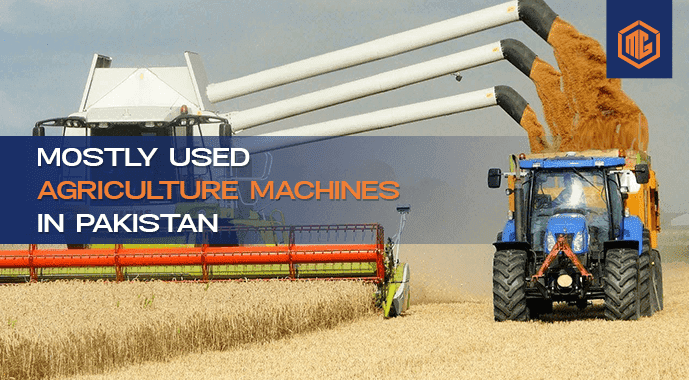
Merge harvester: A merge harvester is an instrument which incorporates grain crop cleaning, threshing, and planting. Farm growing, oats, soybeans, flax (linseed), maize are the key targets.
Sickle: A sickle instrument is a handheld, wedge-shaped agricultural instrument typically used to harvest grain crops or cut yield grass.
Mower: Mower is an instrument for harvesting a crop or plant. The mower may be steam-powered, hand-driven, or animal-drawn. Reaper: Reaper is a method used to collect surface cerels. These kinds of reapers drive either another control tiller or the tractor. The reaper's field power operating mostly on tractors ranges from 0.2 to 0.4 ha per hour at a time.
Crop planting and harvesting device: Plant harvesting equipment is the mechanical device simultaneously designed to collect pasture food grown in the highland or land and shapes the roll bale. The machine involves traveling, harvesting, and a section of the baler.
Vegetable farming machine: For vegetable processing, most machines are now accessible. But they are ubiquitous in the global farming community.
Conclusion
Pakistan has a fertile and extensive mineral commodity core, spanning different environmental and climatic areas. Agriculture plays an essential function in stimulating economic development, both overt and covert. Analysts argue that Pakistan seems to have a vast untapped ability to catch many international agriculture business exports.