Film/Drama industry machines and equipment in Pakistan

Pakistan has been the world's fourth-highest maker of stage productions, mainly during the 1970s and 1980s. However, Pakistan's film industry declined from 1977 to 2007, primarily due to Islamic education, tight censorship rules, and a complete lack of quality. The movie industry passed through so many waves of highs and lows throughout the 1980s and early 1990s, and they were resulting from its reliance on state support and rewards. By 2000, the Lahore movie industry had crashed, and Pakistani stars, celebrities, filmmakers, and directors steadily relocated from Karachi to Lahore.
The injuries of Pakistan's fallen media industry started to recover by 2007, but Karachi became the Pakistani cinema hub. This was when filmmakers of the young generation joined the field with screenplays of quality plot lines. New technologies contributed to the proliferation of alternate forms of Pakistani filmmaking. Unfortunately, Pakistani society has always remained short of adequate quality filmmaking funds.
At the same time, our nation is full of tremendous talent and God-given skill. Nowadays., the Lollywood film industry hardly produces three or four movies a year, which are often funded by big media groups like Geo and ARY. Institutes of media training and media sciences are a prerequisite to producing and growing our growing film industries. The government should play an essential role in restoring Pakistani cinema by providing funds for the cinema industry and supporting and leading the good institutes of our country to offer media studies gross weight.
Therefore, the method will help create potential professional producers with creative concepts and Pakistani film diversification. The people of Pakistan have been tasted to watch Indian movies so far. Our film company should aim to carefully and effectively transform the general public's eyes and interests by making professional films. It is shameful that while our country is full of incredible skill and God-gifted competence.
Pakistani society has often lacked sufficient funds for quality movies. 3 or 4 films are rarely produced by Lollywood, sponsored mainly by massive media organizations like ARY and GEO. For our movie business's production and growth, entertainment training centers and film studies are necessary; therefore, the system will be a good step in producing potential professional producers and directors with creative ideas and diversifying the Pakistani cinema market.
The people of the country have undeniably formed a preference for watching Indian films up until now. Our movie business should strive to deliberately change and successfully attract the community's attention and interests by making better films to fight this phenomenon.
Film/drama industry machines and equipment:
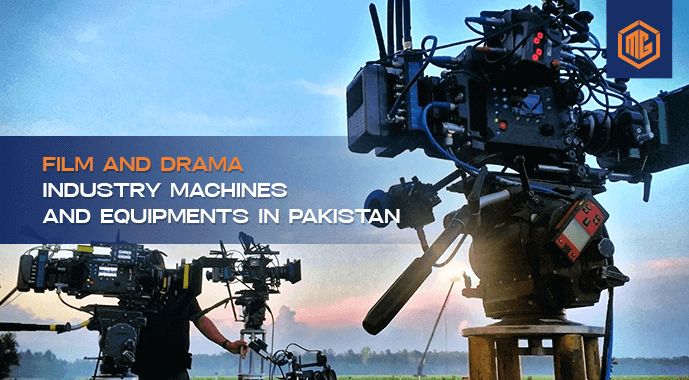
Ever since its founding, movie production has become a famous industry and professional life selection. Despite the luxury, this is a challenging industry that requires constant maintenance to remain ahead of the contest. The facilities are also progressing with the development of the movie industry. You could get the most refined product on the shelf from several expert movie production equipment manufacturers. Many film production facilities are needed when making movies. Some of these appliances are screens, raw stock, clapperboards, audio recorders, still cameras, lighting, boom, camera, reflectors, load-carrying bags, etc. In such a task or shoot, a production manager takes care of any issues and offers the materials as required. Supply has recently been raised for movie production machinery. Not only do these providers provide production facilities with movie production equipment, but they also produce both medium and small independent film movie studios.
Tripod stand
Over several factors, the DSLR tripod is the three-legged filmmaking mate. The most notable is that it helps you hold the camera steady. The distinction between such a smooth shot film and fuzzy chaos is always camera solidity. A tripod is a compact three-legged structure or stands used to hold the mass and retain the balance of some components balance. A tripod brings stability toward downwards forces or against lateral forces and horizontal axis motions.
Reflector of light
A reflector is merely a light-reflecting instrument. A mirror does not create a beam like a flash; it merely reroutes the current brightness and sometimes redirects the light from either a flash or studio backlight. A reflector is also an improvisatory or specific critical angle in photography and camerawork used to divert brightness towards a particular topic or scenario. Bright and soft surfaces tend to be components of good light beam reflectors. These surfaces allow light to reflect (reflect) at the same angle at which the target is struck by light. Coarse and opaque surfaces are features of lower light reflectors, and these surfaces provoke light rays to disperse.
Portable digital recorder
It is a mechanism that transforms sound into a digital file, such as voice and other sounds that can be transferred from one electrical gadget to another. Played back and saved by a monitor, smartphone, or tablet as every additional digital file. There are widely different function sets for such various recording devices, and some would make better sense than most for some uses. There will be built-in microphone recording devices, others that can directly record to internal memory chips, and some that monitor external SD cards.
Video camera
A video camera is equipped to record digital motion pictures compared to a film reel that captures images on film, initially designed for both the TV industry and now used for other purposes. The movie camera that records pictures on film was originally invented for the TV industry but is now also used for other devices. The primary use of recording devices is in two different modes.
Three-point lighting kit
In such a scenario with visible light across three different places, three-point natural light is a typical approach for illuminating a subject. The three kinds of lighting are the leading light, filler light, and backlight. The objective of 3-point light, which is used in conventional photography, filmmaking, and 3D visualizations, is to adequately enhance a subject, using three different lights in a powerful and friendly manner. A three-point device in the theaters could start setting the actor's tone in several cases. This would offer the impression of rage by providing bright, leading light but limited fill and backlight. Suppose the screen is quite brightly illuminated with very little shade on the performer. In that case, this will render the picture appear very cheerful.
Shotgun microphone
The extended the pipe, the further the mic appears spatial. Such characteristics make them great without recording as much of all the other background or surrounding noise for identifying and catching the sound of something far away. Shotgun microphones are often called microphones. From only a range of 6 to 10 feet (ca. 3 m), the pricey shotgun mics record sounds, whereas the less expensive options only record sound at a maximum of 3 to 4 feet (1.22 m).
An annotated script
To record the origins of the script, scriptwriters must annotate specific scripts. Components of the script include actors, incidents, conditions, and dialogues. Usually, annotations are placed at the edge of a script or in the form of endnotes or supporting details to the text. You may ensure that everyone knows what occurs in a document after interpreting it by annotating the content. People must note the author's significant points, changes in the text or point of view of the text, main focus areas, and their thoughts as people interpret, even though people annotate.
Light meter
The system used only to calculate the volume of daylight is a light meter. A light meter, more specifically an exposure meter, is often used in filmmaking to assess the comprehensive guide for a photograph. A 'light meter' is a portable instrument that uses a light scale or meter. In a shot, a light meter may detect the light source or even the bright sunlight from a source of light and measure the proper aperture rate and exposure levels needed to acquire an appropriate exposure. There have been two distinct types of reflective and incident light meters.
Conclusion
Pakistan's film industry declined from 1977 to 2007, primarily due to Islamic education, tight censorship rules, and a complete lack of quality. About three or four movies each year, mostly backed by major media groups such as Geo and ARY, Lollywood's film industry does not make. Media training and media studies are a precondition for the production and growth of our film industry. The people of the country have undeniably formed a preference for watching Indian films up until now. Our movie business should strive to deliberately change and successfully attract the community's attention by making better films.